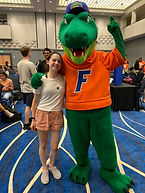
Marin Chester
Growing through ISP


I thought I had my life all figured out when I chose my major during my first year at the University of Florida: I was going to be a wildlife ecologist. Why not? I was fascinated with animals and their "creature powers" as the Kratt Brothers liked to say. Plus, my twin sister also going to UF was undecided in her major, making me the more successful sibling, HAH! Looking back now, I realize how stupid that sounds, especially since she's the one going to med school with her life planned out and I have infinite pathways to choose from in terms of careers in the wildlife ecology realm.
Something that I didn't have planned out when arriving to college was joining ISP. It started when I announced a French and Francophone Studies minor, telling everyone I was consumed by my sunk-cost fallacy of taking French for four years in high school and not wanting to give it up. I ended up taking six French classes for my minor and all of them--even the two I took abroad--were challenging. Every class was taught in French and had homework readings in French: something that I never had in my high school French classes. I struggled to participate confidently in class, until I studied abroad in Paris during my first summer as a college student. The immersion with the language and the culture rekindled my motivation to communicate in French. When I arrived back in Florida, I officially joined ISP--applying my course credits towards the international course requirement--and finished my remaining French classes as one of the most participatory students in the room.
The summer I spent abroad not only improved my confidence speaking French, but also improved my confidence to explore unknown places. During the UF in Paris program, I stayed with a host family in Noisy-le-Sec, a neighborhood in the eastern suburbs around Paris. This meant that I had to navigate a one hour train ride to class every day as well as facing the challenge of communicating in a foreign language with my host family, who didn't speak much English. Despite these stresses, I pushed myself to take risks. One of my friends from the University of Florida at the time was actually in Paris via a layover from a summer vacation, so on my second day in my host family's house I braved the metro system and attempted to meet her at a café. My journey began at 7am--a rough start due to jet lag--, briefly stopped when the bus I was on took a break and I had to question the driver, and finally ended at 9am after I had gotten to a close-enough metro stop and wandered through diagonal streets, finding my friend by tracing her location on my phone! We spent the rest of the day traversing the streets of Paris, finding restaurants out of a Rick Steves book and observing the many dogs under the shadow of the Eiffel Tower. This was the first of many explorations I had abroad, not including a trip to the movie theatre, a day spent in the car with a Swiss couple in the French countryside, and a cross-country trek to a mini-castle museum.
My experience through the ISP program also changed the way I thought about science. When I returned from Europe, I purchased a book called "Rewilding: The Radical New Science of Ecological Recovery" from my local Barnes and Noble, which I now consider the most influential book on my professional interest that I have read. This book introduced me to a concept of science that took an optimistic approach to ecological recovery, was community-based, and challenged the idea of humans "managing" nature to instead help nature and then become hands-off. I agreed with the practices, as they were innovative and bold, which is what I believe conservation needs right now. This book led me to European organizations like Rewilding Britain and inspired me to read "The Book of Wilding: A Practical Guide to Rewilding, Big and Small" this year, which currently pushes me to consider new career paths than my original idea of "wildlife biologist". Being in ISP also encouraged me to value art in science. One of the cultural experiences I attended on campus to fulfill the ISP requirement was a UF Symphonic Orchestra performance. I used to play the violin in an orchestra during high school, so while I had experienced making music, I was excited to play the part of an audience member for once. I still remember how I felt and what I though while I sat in the University Auditorium that night, surrounded by other interested community members. I thought: not everyone will understand science and facts and data, but music can reach everyone. The emotion held in that room that night was the key to harmony and a better world. Later, I took the classes "Human Dimensions of Natural Resources" and "Intro to Public Speaking" that further cemented my belief that emotion and communication are the most important factors when putting science into action.
I'm finally a senior at the University of Florida with a graduation date set for April 30, 2026. I cannot say for sure what career I will have after graduation, but I want to follow whatever my interests are and find that dream job in a non-linear way. Right now, I know that I want to create action that is see-able at a local scale, whether that be as an eco-designer, sustainability coordinator, or environmental journalist. Being a part of ISP has inspired me to travel confidently to find solutions for our environment from global communities and learn how to grow action through the power of artistic communication. I am excited to see what will happen.