top of page
Marin Chester
UF in Paris

While taking my Human Dimensions of Natural Resource Conservation class in Fall 2024, I participated in a virtual exchange activity outside of class. The exchange was with graduate students from the University of Costa Rica and Universidad Austral de Chile. We began communication via WhatsApp texts, using a translator AI to write our messages in English and Spanish. Over the course of this activity three University of Florida students (including myself), one UCR student, and one UACh student interacted through a video call twice while completing assignments surrounding topics of human dimensions in Latin America. The first time we met, we created a Padlet--a type of online presentation--about us and our backgrounds. I included information on where I was from and what I am currently studying at UF. We also decided on a human dimensions topic, after facing initial communication obstacles. I'm not familiar with the Spanish language and was planing on using an audio translator to understand my group members; however, one UF student stepped up to be a translator for me and the international students. He would communicate with the Spanish-speaking members and then relay the information back to me in English. I was so grateful for his help and took advantage of the translation to ask questions about culture in Chile, where one of the students was from. I learned that there is a severe problem about keeping Humboldt penguins as pets. The community sees keeping penguins as a "happy experience" for both the penguin and the owner, like having a companion. However, the fact is that keeping these penguins as pets is detrimental to the health of the penguin and can even serve as a vector for disease. We decided to pursue this issue in our second meeting, where we created a document to identify stakeholders and potential social science methods that we could use to address stakeholders in Chile. Overall, the experience was nerve-wracking at first because of the language barrier, but later I was grateful for having the chance to learn from individuals from a different culture and exposing myself to real difficulties of stakeholder communication in natural resource conservation.
UF Symphonic Orchestra: Les Voyages


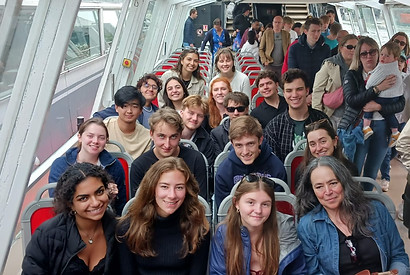
After my first year at the University of Florida, I studied abroad in Paris with the program UF in Paris: Language and Culture. I lived with a host family near the city and took the subway to class everyday. My classes--taught by UF professor Nathalie Ciesco as well as native French speakers--were on the topic of Paris art history, architecture, and daily life. These classes were held in a building in the first arrondissement or while walking around the city. Our daily lessons involved visiting a local food market, going on a scavenger hunt around the city for pastries, and learning about the different cheese of France.
On weekends, we took trips outside of the city to Champagne, St. Malo, Mont Saint-Michel, Versailles, and Strasbourg. My favorite trip was to Mont Saint-Michel and St. Malo. Mont Saint-Michel is a tidal island surrounded by mud flats, on which a great Abbey was built. We explored the small town on the island and walked barefoot on the mud flats while trying not to get our feet stuck in "quicksand". After exploring the island, we spent the night at a very quaint hotel in St. Malo, a port city in Bretagne. This was my favorite destination, with a city wall that allowed for wonderful morning walks and a micro-zoo that housed all kinds of tiny European reptiles and amphibians! I ate mussels and crepes that were signature to Bretagne cuisine and walked across the bay to L’île du Grand-Bé, a channel island that is inaccessible by foot at high tide. It was truly a magical little city on the coast and had an amazing history as a walled city.
Read more about my experience here (in French, of course).
Virtual Exchange: Human Dimensions in Natural Resource Conservation

The University Orchestra performed their concert "Les Voyages" on Monday, September 30th at 7:20pm in the University Auditorium. The concert was focused on works from French composers from the 19th century, including Belioz, Lalo, and Saint-Saëns. The concert began immediately with the Hungarian March from The Damnation of Faust, which was bold and reactive in its tonality. After that introduction, the conductor of the orchestra, Tiffany Lu, gave a brief history of the pieces and how they represented a time of expressive, original French works. At the time, Germany was considered the powerhouse of orchestral music and France wanted to build their own musical identity, with a spot of nationalism found in each composition in this time period. The second piece was a three part cello concerto led by Dr. Steven Thomas. The cello was the main solo here, with accompaniment by the rest of the orchestra in a call-and-response style. I noted that audience members applauded between movements, which is actually wrong to do during a symphony; instead the audience is supposed to applaud at the end of the symphony and all its movements. However, this was remedied by the third piece of the concert. After a brief intermission (the first two pieces only lasted about 40 minutes), the Saint-Saëns organ symphony began. This piece was the shining star of the concert, highlighting the University Auditorium's 100-year-old organ. The tonality of this piece was much more lyrical and strings-focused compared to the other two pieces, at least in the first movement. Finally, the organ comes in about halfway through the first movement, evoking the sound of a large beast. The vibrations of the chords could even be felt in the seats of the auditorium. In the second movement, the organ entered with a chord often heard in church. I recognized this and pointed it out to my friend sitting next to me. Overall, the second movement was much more broad and epic, which fits since it was the conclusion of the concert. I really enjoyed this concert and the use of the organ was very special. I believe that you can learn a lot about culture from listening to music; I took an "Exploring Music" class this past summer that taught me to look for instruments and rhythms that were unique to cultures and places. I found myself searching for "French sounds" throughout the concert and resonated most with the final symphony. Understanding this time period of French history through music is a unique experience, and one that I will gladly expose myself to in the future at other concerts featuring music from different countries and time periods.
bottom of page